Updated 2026 · Independent rankings

Best Bitcoin Mixers 2026: Compared

Independent rankings of the best bitcoin mixers, built on transparent criteria: fees, no-log policies, delay control, Tor access and legal standing. Compare the leading services side by side and pick one that protects your financial privacy without cutting corners on safety.

Mixers tracked
24
Test transactions
180+
Sanctioned listed
0
Inputs Outputs Mixing pool delay: 06h 12m link broken ✓
No-logs policyTor .onion accessLetter of guaranteeCustom delaysMultiple outputsLow mixing feesCoinJoin supportSanctions screening
Ranking · October 2026

Top Bitcoin Mixers Ranked

Our shortlist is rebuilt every month. Each service below was tested with small real deposits, screened against public sanctions lists and scored on six weighted criteria. Rankings are never sold — partners cannot buy a higher position.

Whir Editor's choice

Best overall

  • Fee1.0–3.0%
  • Minimum0.001 BTC
  • Max delay72 h
  • LogsNo logs
  • CoinJoin
  • Tor mirror
  • Up to 8 outputs

Whir is a CoinJoin-based mixing service that complicates transaction tracing and supports flexible delay and output count settings. Well suited for regular medium-sized transactions.

Mixero

Best advanced privacy (Monero route)

  • Fee0.5–3.0%
  • Minimum0.001 BTC
  • Max delay168 h
  • LogsNo logs
  • CoinJoin
  • Advanced mode via Monero
  • Ethereum support
  • Tor mirror

Mixero is built around CoinJoin and offers an "Advanced" mode where BTC is routed through Monero before return — adding an extra privacy layer. Ethereum mixing is also supported, and delays can be set up to 7 days.

Anonymixer

Best for flexible output control

  • Fee1.0–2.0%
  • Minimum0.001 BTC
  • Max delay48 h
  • LogsDeleted 24 h
  • Tor mirror
  • Letter of guarantee
  • Up to 10 outputs

Anonymixer focuses on convenient payout splitting across multiple addresses and a signed letter of guarantee for every operation. Simple order logic and a clear interface.

Coinomize

Best for low fees

  • Fee0.5–2.5%
  • Minimum0.0015 BTC
  • Max delay48 h
  • LogsNo logs
  • Tor mirror
  • Randomised fee
  • Referral program

Coinomize is an easy-to-use custodial mixer with a randomised fee and a working Tor mirror. Convenient for regular small transactions.

Mixtum

Best for beginners

  • Fee1.0–3.0%
  • Minimum0.002 BTC
  • Max delay72 h
  • LogsDeleted 24 h
  • Simple interface
  • Letter of guarantee
  • 24/7 support

Mixtum offers a clean three-step mixing process, supports a letter of guarantee and runs with round-the-clock support — a solid starting point for beginners.

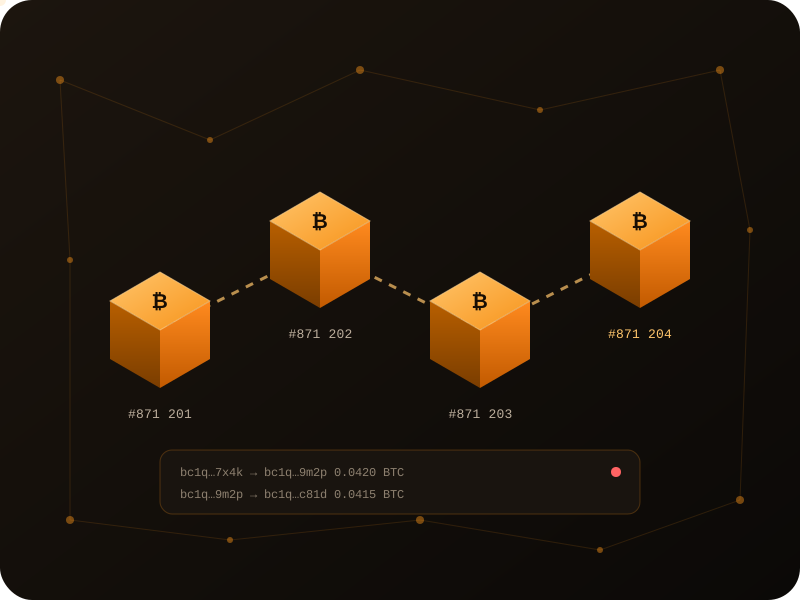
Illustration of linked bitcoin blocks on a public blockchain network, showing how transactions can be traced
The basics

What Are Bitcoin Mixers?

Bitcoin mixers — also called tumblers or crypto mixing services — break the visible link between the address that sends coins and the address that receives them. Every Bitcoin transaction is recorded forever on a public ledger, so anyone who learns one of your addresses can follow the trail: your balance, your income and everyone you pay.

A mixing service pools coins from many users and returns different coins of equal value, minus a fee, to fresh addresses. Done well, it restores what cash has always offered: fungibility. People use them to keep salaries confidential, protect donations, separate business and personal funds, and avoid becoming a target after a large purchase becomes public.

It is worth being clear about what mixing does not do. It does not make coins invisible, and it does not erase their history — it adds a break that makes the history much harder to read. How strong that break is depends on the size of the pool, the delays you choose, how the amount is split and how carefully you handle the coins afterwards. That is why we rank services on process and transparency, not on marketing claims about “total anonymity”.

Read our step-by-step guide to how bitcoin mixers work →
Methodology

How We Rank the Best BTC Mixers

Every service we track is scored out of 10 using the same six weighted criteria. Scores are re-checked monthly and after any incident.

25%

Security & no-logs

How long transaction data is kept, whether deletion is verifiable and how the service protects deposit addresses.

15%

Fees & limits

Service fee range, fixed network fees per output, minimum and maximum amounts, and how clearly costs are shown.

15%

Delay & output control

Custom time delays, number of output addresses and control over how the amount is split between them.

15%

Track record

Years in operation, payout reliability in our tests and how the team handled past complaints or outages.

15%

Legal standing

Sanctions screening, public enforcement history and whether the service refuses obviously illicit funds.

15%

Usability & Tor

Interface clarity, support quality and a working Tor mirror that does not require JavaScript to complete an order.

Crypto mixers at a glance

Three Types of Crypto Mixers

Not every service works the same way. The model decides who holds your coins during mixing and how much trust you place in the operator.

TypeWho holds coinsTypical costMain trade-off
Custodial mixerThe service, briefly0.5–5% + network feeSimple, but you trust the operator
CoinJoinYou keep your keysCoordinator fee + miningTrust-minimised, more technical
Swap-based routesDepends on the routeSwap spread + feesFast, but weaker for large amounts

Which model should you pick?

If you value simplicity and want to choose your own delays and output split, a custodial service is the easiest route — as long as it has a long, clean track record and signs every order. If you would rather never hand over your coins, CoinJoin is the stronger option, but it asks for more patience and a compatible wallet. Swap-based routes are convenient for small, occasional amounts, yet rarely the best choice when privacy really matters. Many experienced users combine models rather than relying on one.

Orange shield with a padlock protecting a stream of on-chain transactions
Why it matters

Why On-Chain Privacy Matters

Bitcoin is often described as anonymous, but it is closer to the opposite: a permanent, public record that anyone can search. Blockchain analytics firms cluster addresses, label exchange deposits and connect payments into detailed financial profiles. Once a single address is tied to your name — through an exchange withdrawal, an online purchase or a donation page — much of your history can follow.

That exposure has real costs. Employers and business partners can see what you earn and spend, merchants can see your full balance when you pay them, and anyone who notices a large holding may decide you are worth targeting. Financial privacy is not about hiding wrongdoing; it is the same discretion people expect from a bank statement, and it is a normal part of using money safely.

Step by step

How to Mix Bitcoin Safely

Even the highest-rated service can only protect you if the order is placed carefully. These five habits matter more than which name you choose from the ranking.

  1. Use the official address only

    Open the service from a link you trust and compare it with the mirrors listed in our reviews. Clone sites copied from forums and search ads are the most common way people lose funds.

  2. Connect over Tor

    Use the .onion mirror or another privacy-preserving connection so the operator cannot link your order to your IP address.

  3. Save the letter of guarantee

    Before sending anything, verify the signed letter against the public key on the official site and keep a copy until the payout is complete.

  4. Start with a small test

    Send an amount just above the minimum first. A clean, on-time payout tells you more about a service than any review.

  5. Use fresh, separate addresses

    Send outputs to new addresses that have never been linked to you, choose randomised delays and avoid merging the coins back together afterwards.

Common mistakes that undo the result

  • Sending the output straight to an exchange account registered in your name.
  • Withdrawing exactly the amount you deposited, minus the fee, within minutes.
  • Combining mixed and unmixed coins in a single transaction.
  • Reusing an output address for anything else after the payout.

Full 8-point safety checklist →

Mixing for personal privacy is legal in many countries, but rules differ widely and several services have been sanctioned or shut down. Never use mixing to hide proceeds of crime or evade sanctions — that is illegal everywhere and not what privacy tools are for. Check your local law, keep records of where your funds came from and expect some exchanges to ask questions about mixed coins.

Quick answers

Bitcoin Mixers FAQ

Are bitcoin mixers legal?

It depends on your jurisdiction. Using a bitcoin mixer for personal privacy is legal in many countries, but several mixing services have been sanctioned or shut down, and using any such service to hide criminal proceeds is illegal everywhere. Always check local law first.

What is the best bitcoin mixer right now?

Our current number one is Whir, chosen for its no-log policy, flexible delays and consistent payouts in our tests. The best choice for you depends on amount, fee tolerance and whether you prefer a custodial service or a CoinJoin wallet.

How much do btc mixers charge?

Most custodial btc mixers charge a service fee of roughly 0.5% to 5% plus a small fixed network fee per output. CoinJoin coordinators usually charge less, but you also pay on-chain mining fees.

Can mixed bitcoin be traced?

Sometimes. A small pool, unusual amounts, tight timing or careless reuse of addresses after the payout can let analysts link inputs and outputs again. Randomised delays, several outputs and good habits afterwards make tracing far harder, but no service can promise it is impossible.

How long does mixing take?

Usually from under an hour to a few days. Custodial services wait for one to three network confirmations and then apply the delay you chose. CoinJoin rounds depend on how quickly enough participants join. Longer, randomised delays generally give better privacy.

Do I need Tor to use a mixing service?

It is not strictly required, but it is strongly recommended. Without Tor the operator can see your IP address, which links the order to your connection. Most reputable services publish an .onion mirror — copy it only from the official site.

See all frequently asked questions →

Compare every service we track

Filter the full list by fees, Tor access, CoinJoin support and no-log policy.

Open the list